샤플 이용료 80% 지원 받기
If you work in trade marketing, modern channel, or retail, you know perfectly well that one of the most common—and most costly—problems is this:
The planogram looks perfect in PowerPoint... but in-store everything is different.
One day you find your display impeccable.
The next, it's incomplete, mixed, or displaced by the competition.
It happens in supermarkets, pharmacies, convenience stores, clubs, wholesalers... in any channel.
And the most frustrating thing is that, even when your promoters visit stores:
• There's no consolidated evidence
• Each supervisor interprets the planogram differently
• Reports arrive via WhatsApp, without order
• There's no real way to validate execution
But what does exist are lost sales, poorly utilized spaces, invisible out-of-stocks, and negotiations that fall through due to non-compliance.
That's why talking about Planogram Compliance is no longer a "nice to have."
It's the foundation for protecting your POS investment.

It's not just "following a drawing."
It's not taking a photo and sending it to the group either.
Planogram compliance means:
• The store displays EXACTLY what you agreed upon
• Furniture, facings, heights, and SKUs match what was planned
• Space is respected according to negotiated percentages
• Photos verify real execution
• The brand maintains constant and repeatable visibility
It's basically converting the plan into reality.
And in Mexico, where competition makes daily moves, whoever controls their planogram controls their category.
Years supporting brands and agencies in retail show us 6 critical causes:
Even within the same chain, floor teams make "temporary" modifications that never return to normal.
Photos arrive via WhatsApp, without context, without metadata, without store name.
When HQ receives the report, days have passed. Errors remain in-store.
Many planograms are delivered as heavy PDFs or confusing images.
There's no single dashboard to verify execution by region, chain, or team.
Excel, presentations, loose photos... complete chaos.
And that's why brands need a tool that makes simple what was previously impossible.

Here's the most practical flow—used by the most mature trade teams in LATAM—to achieve real uniformity.
Nothing huge files or illegible PDFs from a cell phone.
The best teams use:
• Clear images
• Diagrams by category
• Reference photos
• View by module or linear meter
It must be understandable in 5 seconds, not 5 minutes.
If the promoter has to open WhatsApp, then search for a PDF, then take photos... efficiency is already lost.
The ideal:
Everything within the same app.
Planogram → Execution → Evidence → Approval.
Example:
• Front photo
• Side photo
• Close-up of facings
• Out-of-stock image (if applicable)
• Visible price
With metadata and location. Not random photos.
The supervisor sees:
• Which store already complied
• Which is "pending"
• Which has errors
• Which SKU is missing
• Who executed correctly
Without waiting for weekend reports.
Serious brands measure:
• % compliance by store
• % compliance by chain
• Recurring non-compliance
• Stores that need additional visit
• SKU with most breaks
Without this, the planogram becomes a suggestion... not real execution.

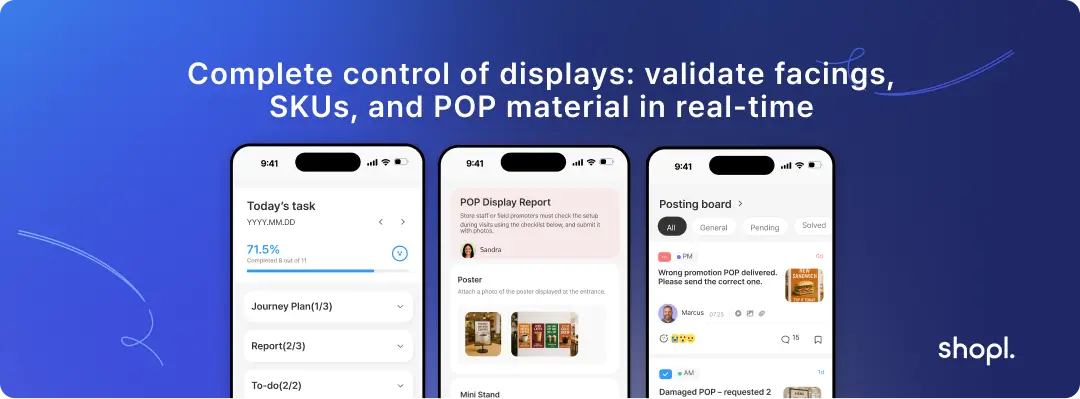
Shopl was designed exactly for this.
The promoter can see:
• Assigned planogram
• Corresponding POP
• Reference photos
• Brand instructions
All from their cell phone.
No WhatsApp. No loose files.
Each photo is saved with:
• Time
• Date
• Store
• Coordinates
• User who captured it
Reliable evidence = real control.
The system places steps like:
• Is SKU A at the correct level?
• Complete facings?
• POP material installed?
• No competition in assigned space?
And marks compliance.
HQ can see:
• Compliance level by region
• Stores that failed
• SKU with recurring problems
• Before/after photos
• Execution times
It's the dream of any trade marketing manager.
Forget consolidating photos or building manual PowerPoints.
Shopl generates:
• Reports by store
• Reports by chain
• Reports by category
• Compared historical data
• Trends by month
And with this, compliance stops being luck... and becomes a process.
Companies that standardize their execution see:
• +12% increase in sales per category
• 30% reduction in shelf breaks
• Up to 8 more points in space share
• Similar executions in stores of the same chain
• More productive teams and more agile supervision
There's no more profitable trade strategy.
Planogram compliance is not about "perfectionism."
It's about:
• Profitability — Each lost facing is money you stop earning
• Competitiveness — Whoever controls their space, controls their category
• Credibility — Without evidence, there's no negotiation
• Scalability — You can't grow without repeatable processes
And in Mexico, where the battle for POS is won or lost every day, having a system that guarantees uniform execution is no longer optional.
It's the difference between a brand that executes... and a brand that only plans.
The question is not if you need planogram compliance.
The question is: how much longer will you wait to implement it?