샤플 이용료 80% 지원 받기
Why many brands confuse concepts... and how that directly affects in-store execution
In retail, few discussions generate as much confusion as this:
"That's a trade marketing issue."
"No, that's execution."
"That's operations' responsibility."
The result is usually the same:
• Unclear responsibilities
• Misaligned teams
• Duplicated tasks
• Errors no one assumes
• Inconsistent in-store execution
The problem is not semantic.
It's operational.
Confusing retail execution with trade marketing causes strategy not to translate correctly at point of sale.
This blog explains the real differences between both concepts and, more importantly, how to align them to improve POS results.

Trade marketing focuses on designing the commercial strategy for the channel.
It includes decisions like:
• Which promotions to launch
• Which POP materials to produce
• Which planograms to define
• Which activations to execute
• Which incentives to offer the channel
• How to negotiate spaces and visibility
In short:
Trade marketing defines the "what" and the "why."
It's a strategic function, oriented to planning and design.
Retail execution focuses on making what was planned happen correctly in-store.
It includes activities like:
• POS visits
• POP installation
• Planogram execution
• Promotion validation
• Replenishment
• Photographic evidence
• Audits
• Real-time supervision
In short:
Retail execution handles the "how," "when," and "where."
It's an operational function, oriented to execution and control.

Both are indispensable.
But one doesn't work without the other.
In Mexico, this is the most frequent scenario:
• Trade marketing defines campaigns
• Operations "downloads" instructions
• Field executes as they can
• There's no real visibility
• Errors are detected late
• Trade blames execution
• Execution blames trade
And the cycle repeats.
The problem is not the team.
It's the lack of connection between strategy and execution.
When there's no alignment, these appear:
• Poorly executed promotions
• Incorrectly installed POP
• Inconsistent planograms
• Different messages per store
• Loss of credibility with the channel
• Wasted investment
A perfect campaign in PowerPoint can fail completely in-store.

Alignment is not just another meeting.
It's a shared system.
Trade and execution must work on the same information:
• Same guidelines
• Same images
• Same tasks
• Same KPIs
Not different versions per area.
Each trade initiative must translate into:
• Concrete tasks
• Clear instructions
• Required evidence
• Compliance criteria
Without free interpretation.
Photos and audits must answer strategic questions:
• Was the promotion executed?
• Was the planogram respected?
• Is the POP visible?
Evidence is not decoration.
It's strategic validation.
Trade and execution must evaluate success with the same indicators, not isolated metrics.
Example:
• % promotion execution
• % planogram compliance
• Real POS visibility
If something is not executed well, trade must know the same day, not at campaign close.
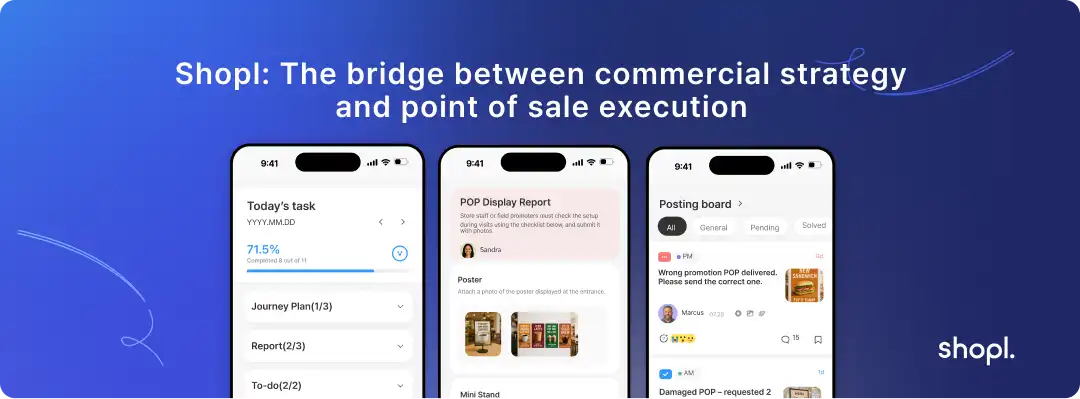
Shopl acts as the bridge between strategy and execution.
It allows:
• Trade to upload guidelines, POP, and planograms
• Operations to convert that into clear tasks
• Field to execute with visual guidance
• Evidence to return structured
• KPIs to reflect real execution
All in one platform, without friction between areas.
Brands that align trade and execution achieve:
• Better executed campaigns
• Fewer reworks
• Less internal wear
• Better relationship with the channel
• Higher trade marketing ROI
• Faster decisions
Execution stops being a risk and becomes a competitive advantage.
Trade marketing and retail execution don't compete.
They complement each other.
Strategy without execution is theory.
Execution without strategy is improvisation.
The brands that win at POS are those that connect both worlds in a single operational flow.