샤플 이용료 80% 지원 받기
A near miss is any incident where something almost went wrong — but didn't. No injury, no damage, but a clear signal that danger is present. When these moments go unrecorded, the hazard stays hidden. This guide covers what near misses are, how to document them properly, and how to build a reporting system that actually prevents serious incidents.
A near miss is an unplanned event that had the potential to cause injury, illness, or damage — but didn't, often by luck or chance. Think of it as a warning shot: no one got hurt this time, but the conditions for a serious accident were clearly there. In workplace safety, near misses are treated as critical early indicators, not minor inconveniences to brush off.
Heinrich's Law, developed by industrial safety pioneer Herbert William Heinrich, describes a ratio that safety professionals still reference today: for every single major injury, there are 29 minor incidents — and behind those, 300 near misses.
The takeaway for store managers and supervisors is direct: serious accidents don't appear out of nowhere. They're preceded by dozens of smaller warning signs that went unaddressed. Catching and acting on near misses is how you stop the pattern before it escalates.
When a near miss isn't recorded, the hazard doesn't disappear — it waits for the next person. One employee might know that a particular spot is dangerous, but if that knowledge stays in their head and never gets logged, every new staff member faces the same risk without any warning. An unrecorded hazard is, for all practical purposes, invisible to the organization. It can't be fixed, escalated, or learned from.
In many workplaces, near misses go unreported not because staff don't notice them, but because reporting feels too difficult or pointless. Common reasons include: "It feels like admitting I made a mistake," "I don't have time to fill out a form during a busy shift," or "Nothing changes when I do report it." When this attitude takes hold, hazard information stops reaching management — and leadership ends up operating under the false impression that everything is fine. A near miss reporting system that exists on paper but goes unused is a silent incubator for serious accidents.
Be specific. "Yesterday evening near the entrance" doesn't give enough information to act on. A useful report includes the exact date and time, a precise location within the facility, and a clear description of what occurred. Vague entries make it impossible to identify patterns or assign corrective actions.
Describing what happened is only the starting point. Understanding why it happened is where prevention begins. Look beyond the immediate trigger (the floor was wet) to the underlying cause (there was no standard procedure for placing wet floor signs after cleaning). Without the root cause, the same incident is likely to recur.
"We'll be more careful going forward" is not a corrective action. A credible response names who is responsible, what they will do, and by when. For example: "Effective immediately, the shift leader will verify that wet floor signs are in place before clearing any staff from a cleaning zone. (Owner: Shift Leader, effective today.)"
The report should clearly identify who submitted it and who reviewed or approved it. This establishes accountability and ensures follow-up actions don't fall through the cracks.
When every location uses a different format, comparing data across sites becomes impractical. A single standardized template, used consistently across all stores or facilities, allows management to identify trends, spot repeat issues, and develop organization-wide prevention measures. Standardization also makes it easier to onboard new staff to the reporting process.
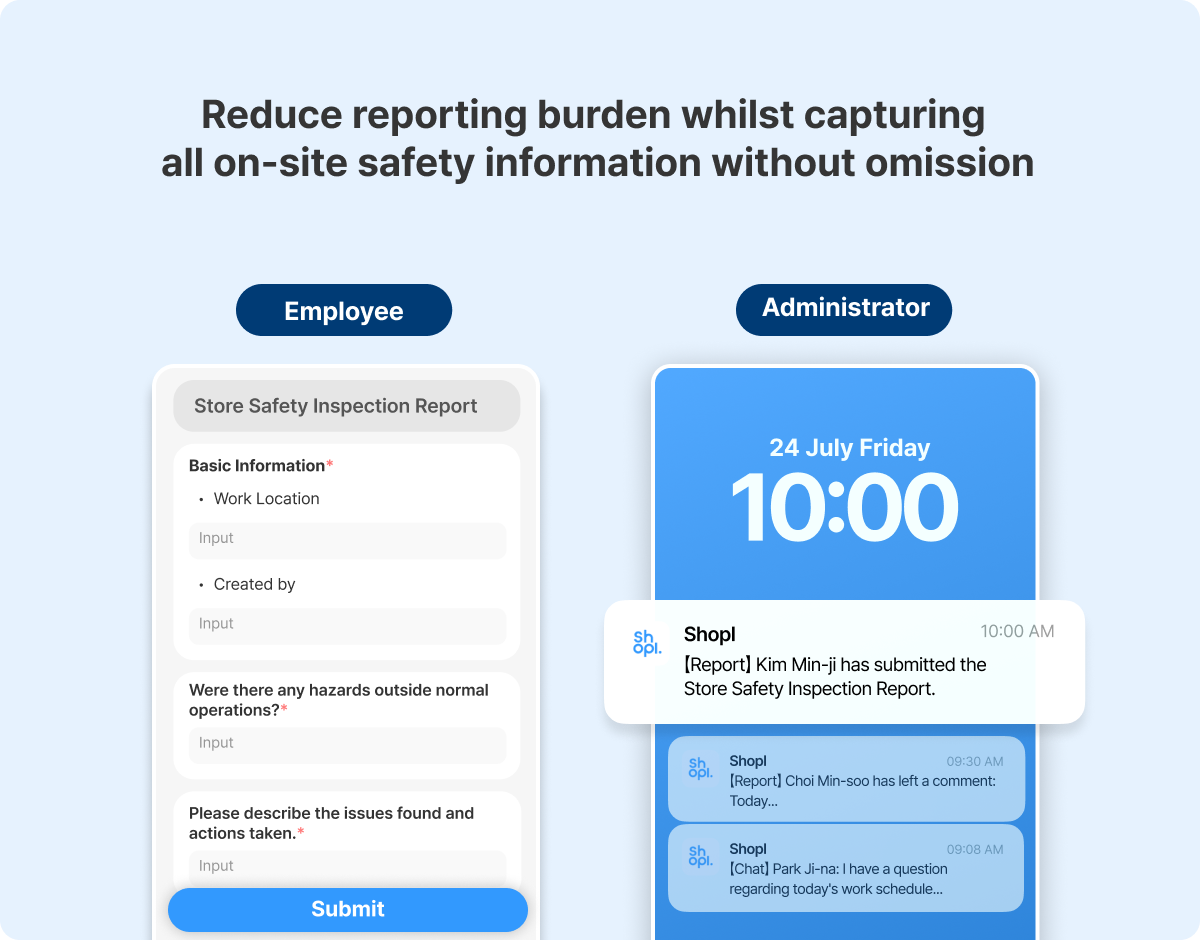
One of the biggest reasons near miss reporting fails is that the process itself gets in the way.
Asking a staff member to track down a paper form, fill it out by hand, and submit it through a separate channel during a busy shift is a significant ask. Most small hazards get mentally filed away as "I'll report it later" — and later never comes. If you want staff to consistently report near misses, the process needs to be fast enough to complete in the moment it happens. Shopl's Report feature lets field staff submit near miss reports directly from their phones, and managers receive all submissions in a consistent format — no chasing down paperwork, no gaps between locations.
▸ How Field Verify Task Completion with Photo Proof >
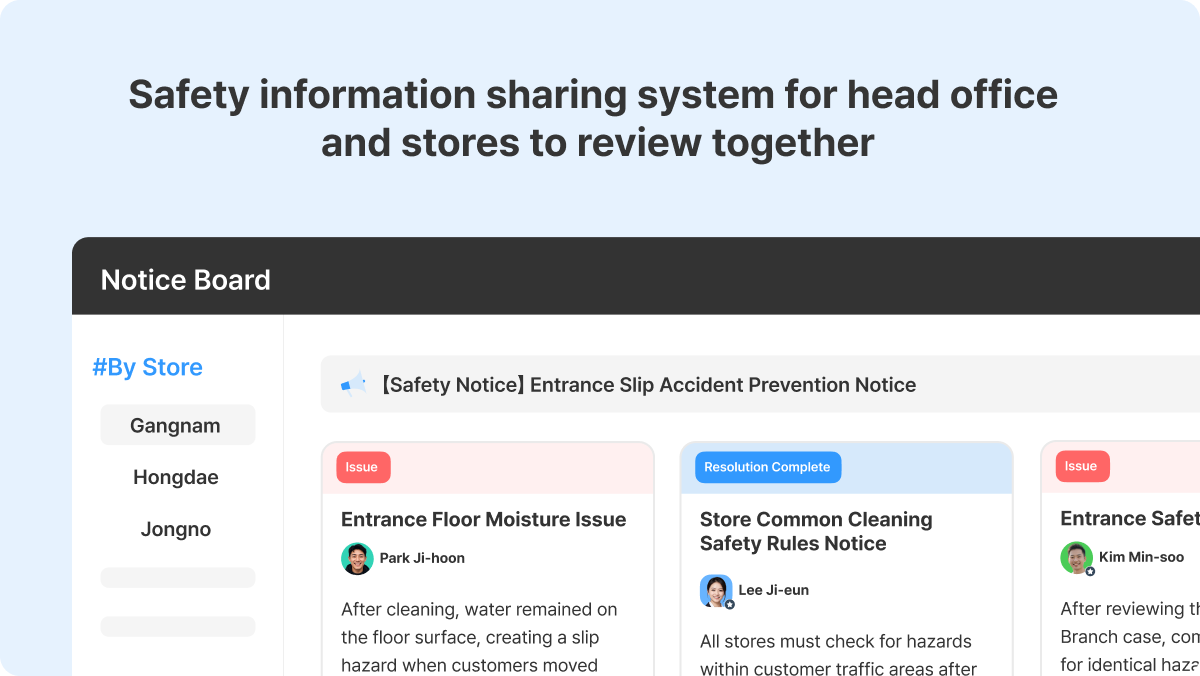
In multi-location operations, the same hazard often reappears across different stores — because what happened at one location was never shared with the others.
When near miss reports stay siloed within individual stores, headquarters has no way to see which risks are recurring across the network. The result is the same preventable incident happening again at a different location, with no one connecting the dots.
Shopl's Bulletin Board feature gives HQ and store teams a shared space to post and access safety information. A store that experienced a near miss can share what happened and what corrective action was taken. HQ can push updated safety guidelines or alerts to all locations at once. Safety knowledge that used to be locked inside individual stores becomes something the whole organization can learn from — and act on together.
▸ One Channel for HQ–Store Communication: How to Make It Work with Board >
An accident results in actual harm — injury to a person or damage to property. A near miss is an event that could have caused harm, but didn't. The distinction matters because near misses are often dismissed as "nothing happened," when in reality they signal that the conditions for an accident already exist. As Heinrich's Law shows, near misses are the early warning stage — and that's exactly when intervention is most effective.
There's no legally mandated form in most jurisdictions. What matters is consistency. Building an internal template that captures the five elements outlined above — date, location, root cause, corrective action, and responsible parties — gives your organization the data it needs to spot patterns and prevent recurrence. The value comes from using the same format across every location, every time.
Yes — and in some ways the need is more acute. In a small team, safety knowledge is often held by one or two individuals. When those people are off or leave the company, that knowledge walks out with them. A documented record ensures that hazard information survives staff turnover and stays accessible to whoever is running the floor.
Paper forms and email chains don't scale. As the number of locations grows, so does the risk of reports getting lost, delayed, or never reaching the right person. A digital tool that aggregates reports from all stores in one place lets HQ see trends as they emerge — which locations are flagging similar issues, which hazard types are most common — and prioritize corrective action accordingly.
Building a reliable near miss reporting system comes down to two things: making it easy for staff to report what they see, and making sure that information reaches the people who can act on it. Shopl's Report and Bulletin Board features are designed to do exactly that — connecting field observations to organization-wide safety improvements. If you're looking to move your near miss management off paper and into a system that actually works, explore what Shopl can do for your operation.
To learn more about building a digital safety reporting workflow, visit the Shopl product page.