샤플 이용료 80% 지원 받기

Operational inconsistency doesn't fix itself. When different stores or team members handle the same tasks in different ways, the gap widens over time — and by the time it surfaces as a customer complaint or a quality issue, it's already cost you. Standardization only works when it's built into how work actually gets done on the floor, not just written into a manual that sits in a shared drive. Identifying where the gaps are, putting follow-through systems in place, and keeping them running consistently — that's what stable store operations look like.
'Work standardization' and 'work leveling' are often used interchangeably, but they address very different problems.
Work standardization is the foundation for eliminating inconsistency across your stores. Even when procedures are documented, different staff members will interpret them differently if there's no system in place to verify execution and deliver feedback. This guide focuses on work standardization — specifically, how to make it take hold on the floor and what steps to take to get there.
In stores with high staff turnover, newer team members often start handling Tasks before they've fully understood the right way to do them — and without strong oversight, those gaps go unnoticed. For supervisors and headquarters teams managing multiple locations, there's long been no reliable way to confirm whether every Store is actually operating to the same standard.
Inconsistent customer experiences, rising complaints, and quality risks rarely have a single cause — but differences in how Tasks are carried out from one Store or team member to another is frequently a contributing factor.
Long-tenured staff naturally develop their own methods — and over time, those methods become "how we do it here," passed down to newer hires as if they were official. Once a Store's local habits drift away from company Rules, they're difficult to correct after the fact.
A manual only helps if someone checks whether it's actually being followed. When verification relies on verbal confirmations or messages over WhatsApp, missed steps leave no paper trail — and compliance quietly erodes over time.
When directives go out from HQ but there's no reliable way to see how each Store has responded, problems stay invisible until they've already escalated. That information gap is where inconsistency breeds.
Before you can fix anything, you need to know where the gaps actually are. That means collecting Data that lets you compare execution across Stores and staff members. Without visibility into what's happening on the floor, you can't prioritize what needs to be addressed first.
Vague instructions are interpreted differently by different people. A well-built Checklist spells out what needs to be done, when, in what order, and what "Completed" looks like — leaving no room for guesswork. Adding Photos or specific numeric Criteria further reduces variation between staff members.
Distributing a Checklist isn't enough on its own. Someone needs to be checking whether Tasks are actually getting done — and when they're not, there needs to be a clear escalation path. Decide in advance how often checks happen, who's responsible, and what the follow-up process looks like.
If staff on the floor find certain procedures difficult to execute but have no way to communicate that upward, those problems go unresolved. Creating a clear Channel for floor-level feedback — and building in regular procedure reviews — is what keeps standardization from going stale.
"Handle it as soon as possible" or "please confirm as appropriate" leaves too much open to interpretation. Different staff members will act at different times, to different standards. Every directive should answer: who does what, by when, and to what Criteria — that's what stops inconsistency before it starts.
When HQ has to chase each Store individually to confirm execution, the Admin burden adds up fast — and things slip through. Having a centralized view of Completed vs. Incomplete Tasks means you can immediately spot which Stores need follow-up, without the back-and-forth.
%20%E1%84%8B%E1%85%B5%E1%84%86%E1%85%B5%E1%84%8C%E1%85%B5%2003.jpg)
When procedure updates or operational changes are communicated verbally or via WhatsApp, there's no way to confirm who actually received and understood the information — and that's where inconsistency starts. With Shopl's [Notice & Survey] feature, you can send updates to specific Assigned by groups and instantly see who has and hasn't read the Notice. A re-send Push Notification to anyone who hasn't confirmed means nothing falls through the cracks — HQ can be confident that every Store is working from the same Information.
▸ Send the Right Announcement to the Right Role — Every Time >
%20%E1%84%8B%E1%85%B5%E1%84%86%E1%85%B5%E1%84%8C%E1%85%B5%2002.jpg)
When each Store reports in its own format, consolidating that Information at HQ takes time — and comparing Store performance becomes nearly impossible. With Shopl's [Report] feature, you can build standardized forms so every Store submits Results in the same structure. That consistency makes it far easier to spot which Stores are on track and which need follow-up, without hours of manual aggregation.
▸ Collect Structured Work Reports Without WhatsApp or Chat Apps >
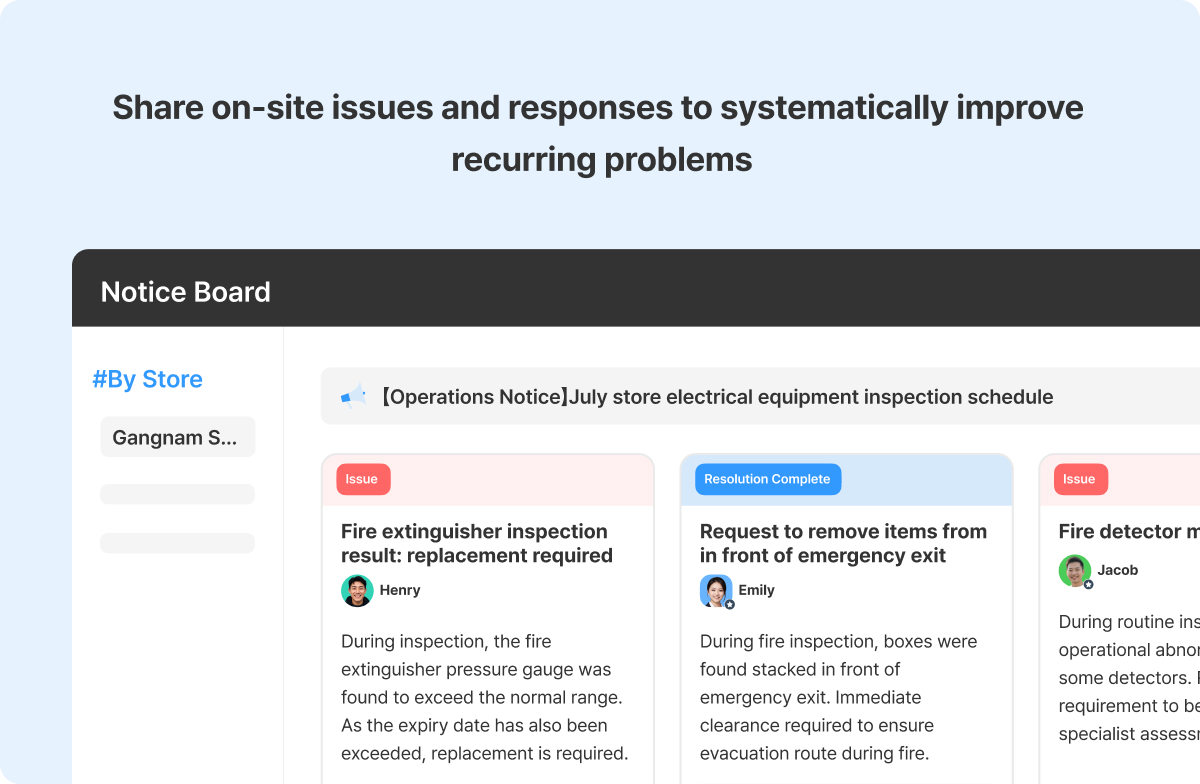
Even well-designed procedures hit unexpected problems in real Store environments. Shopl's [Issue & Resolved Posting Board] lets each Store log problems as they Accrued, track progress through resolution stages, and keep a full record of how each issue was handled. That paper trail makes it easier to spot patterns — and when one Store finds an edge case or a smarter workaround, it becomes a Reference point for improving operations across all locations.
▸ How HQ Can Systematically Collect Improvement Ideas from Frontline Staff >
A. Work standardization is about making sure Tasks are carried out the same way across all staff and locations.
Work leveling is about making sure no single person or period carries a disproportionate share of the workload. They solve different problems — so the right place to start depends on which issue is most pressing for your operation.
A. Any Organization where multiple people or locations are handling the same Tasks.
It's especially critical in retail, Food service, and other service industries with large Store networks or high part-time staff counts — because when the people doing the work change frequently, inconsistency in execution directly affects quality.
Inconsistency on the floor isn't just a training problem. It happens when Criteria aren't clear, when Instructions don't reach everyone, when there's no system to verify execution, and when floor-level problems never make it back to HQ. The fix starts with defining clear standards, building in a way to confirm they're being followed, and regularly reviewing Results to keep improving. That cycle — set, verify, improve — is what work standardization actually looks like in practice.