샤플 이용료 80% 지원 받기
What to measure, how to do it, and why most brands in Mexico are doing it wrong
In retail, almost all brands say they measure their operation.
Few can say they understand it.
Because having data is one thing...
and having actionable KPIs that allow you to answer real questions is quite another:
• Which stores are failing today?
• Which promoters execute better and which need support?
• Where is execution being lost before it affects sales?
• Which region complies and which only "reports"?
The problem is not the lack of information.
The problem is that the wrong things are measured, or they're measured too late.
This article explains which are the key KPIs to measure point of sale execution, how to interpret them, and how to convert them into real decisions, not reports that no one reads.

POS execution is the point where strategy becomes reality.
That's where you win or lose:
• Brand visibility
• Product availability
• Promotion compliance
• POP material impact
If you don't measure execution correctly:
• You react late
• You correct poorly
• You punish the wrong team
• You repeat mistakes month after month
The right KPIs allow you to move from reactive operation to proactive retail management.
In Mexico it's very common to find:
• 20 metrics in an Excel
• Photos without context
• Weekly reports that arrive when they're no longer useful
• Indicators that no one reviews
Measuring more doesn't mean measuring better.
A good KPI system must meet three rules:
• Be clear
• Be comparable
• Be actionable
If it doesn't meet these three, it's noise.

What it measures:
What percentage of planned visits were actually executed.
Why it matters:
If there's no visit, there's no execution. Period.
Real example:
Planned route: 20 stores
Visits made: 16
Compliance: 80%
👉 Every subsequent KPI depends on this one.
What it measures:
If check-ins are made within the expected schedule.
Why it matters:
Arriving late impacts:
• Replenishment
• Activations
• Relationship with the channel
This KPI reveals route problems, workload issues, or operational discipline.
What it measures:
How much real time the promoter spends executing at POS.
Why it matters:
• Too little time → superficial execution
• Too much time → poorly optimized routes
This KPI helps adjust workloads and zones.
What it measures:
What percentage of visits have correct, complete, and valid evidence.
Includes:
• Real photos
• Correct location
• Coherent schedule
• Relationship with the task
Without reliable evidence, there's no verifiable execution.
What it measures:
If the product is placed as defined.
Why it matters:
A poorly executed planogram is a silent lost sale.
This KPI connects execution with commercial strategy.
What it measures:
If promotional material is:
• Placed
• Complete
• Visible
• In good condition
It's one of the most neglected KPIs and one of the most visible to the shopper.
What it measures:
Problems reported at POS:
• Out-of-stocks
• Damaged displays
• Competition invading space
• Channel rejection
This KPI is key to prioritizing commercial actions.
What it measures:
Relationship between visits, completed tasks, and time invested.
Why it matters:
Allows identifying:
• Top performers
• Training needs
• Operational overload
This KPI changes subjective conversations into real data.

Not because they're poorly defined, but because:
• Information arrives late
• Data is scattered
• There's no relationship between evidence and metric
• Everything is consolidated manually
When KPIs are built from WhatsApp, Excel, and emails, they lose value before they're born.
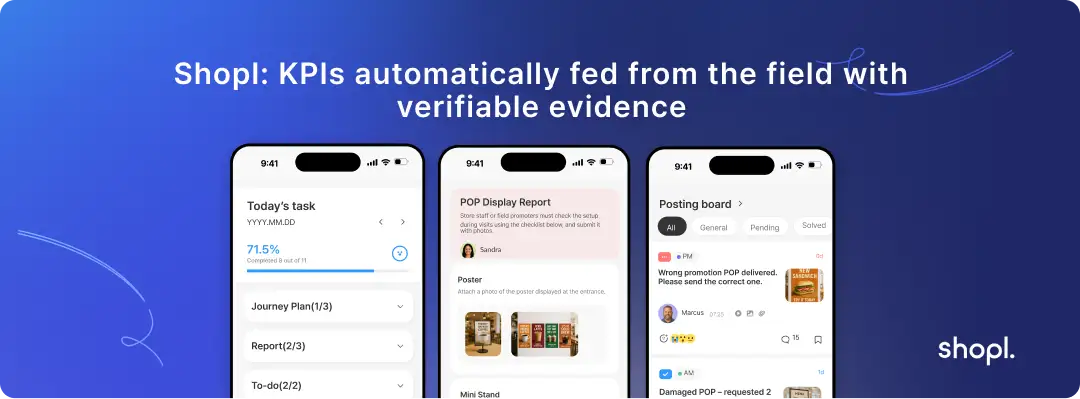
Shopl allows KPIs to be not just numbers, but daily management tools.
What makes it different:
• KPIs automatically fed from the field
• Photographic evidence linked to each metric
• Real-time dashboards
• Comparison by store, promoter, route, or region
• Immediate visibility of deviations
This allows the HQ team to:
• Act the same day
• Prioritize correctly
• Stop "chasing reports"
• Make decisions based on facts
Improvement in execution doesn't come from measuring more,
but from measuring better and faster.
Point of sale execution is not managed with intuition.
It's managed with clear, reliable, and actionable KPIs.
The brands that dominate retail in Mexico are not those with the most reports,
but those that read their operation better and act on time.