샤플 이용료 80% 지원 받기

In most companies in Mexico, field team growth almost always brings the same problem:
The more people in the field... the greater the loss of control.
What starts with 5 promoters becomes chaos with 20. And when you reach 50 or more, control simply breaks:
• You don't know who already arrived at the store
• You don't know who's running late
• You don't know who won't arrive
• You don't know which stores were left unvisited
• You don't know what problems are occurring right now
And then the most common solution is usually: "Let's hire more supervisors."
But that increases payroll, not necessarily control.
The real solution today is only one: real-time supervision with real data.

Real-time supervision is not:
❌ Having a WhatsApp group
❌ Asking for photos at the end of the day
❌ Receiving Excel reports at the end of the week
❌ Trusting that "they surely already went"
Real-time supervision means being able to see, while it's happening:
• Who already checked in
• Which store each promoter is at
• How long they've been on the floor
• If they already took evidence
• If they're running late
• If a visit was lost
• If a route is deviating
All in the moment, not after.
You find out when the client already complained.
The report says yes... but the store says no.
You're always putting out fires. You never prevent problems.
Promoters skip stores, shorten routes, improvise.
There are only excuses, not objective information.

Traditional supervision is not only inefficient.
It's extremely costly and doesn't scale.
Hypothetical scenario:
Company with 40 promoters and traditional supervision
Typical structure:
• 40 promoters in the field
• 3 supervisors (1:13 ratio)
• Physical supervision 2-3 times per week
• Manual reports at the end of the day
• No real-time visibility
The problem of scaling traditional supervision:
If your operation grows from 40 to 80 promoters:
❌ You need 6 supervisors (you double payroll)
❌ You double travel expenses and gas
❌ You double time in transit
❌ You DON'T double control — you only double organized chaos
Cost of supervising 80 promoters traditionally:
• $246,000 MXN monthly
• $2,952,000 MXN annually
Retail industry data in Mexico:
✓ 73% of supervisors spend more than 40% of their time in transit, not supervising
✓ 61% of companies don't detect lost visits until the client complains
✓ 54% of field teams don't have real-time visibility of their operation
✓ 68% of brands report that their supervisors are "overwhelmed" and can't grow
✓ The average supervisor:promoter ratio in Mexico is 1:12-15, but should be 1:25-30 with technology
The question that changes everything:
"What would happen if your supervisors could see 40 stores at the same time without moving from their desk?"
That's exactly what real-time supervision allows.
A professional supervision system must fulfill exactly this:
See from a map:
• Active promoters
• In transit
• In store
• Absent
Each entry is registered with:
• Real location
• Exact time
• User
• Store
Photos, notes, audits, and tasks are received in real-time.
The system notifies when:
• Someone didn't arrive
• Someone is outside schedule
• A store didn't receive a visit
• Evidence is missing
No need to request manual reports.
Everything builds itself.

Shopl allows supervision without increasing payroll because:
• It centralizes the entire operation in a single panel
• It shows routes, visits, evidence, and times in real-time
• It eliminates the need for constant physical supervision
• It allows intervention when the problem can still be corrected
With Shopl you can:
• Detect delays before they affect sales
• Correct routes in real-time
• Validate visits without moving from the office
• Audit evidence immediately
• Measure real productivity by promoter, store, or zone
Companies that migrate from traditional to digital supervision obtain:
• +30% route compliance
• –40% lost visits
• –50% downtime
• –35% channel complaints
• –20% operational supervision expense
Not because they work more. Because now they work with data.
These are the changes we consistently see in teams that migrate to real-time supervision:
Typical case in Mexico (based on market behavior):
Activation company with 40 promoters:
BEFORE (Traditional Supervision):
Structure:
• 3 field supervisors
• 40 promoters
• Excel reports at the end of the day
• Evidence via WhatsApp
• Physical supervision twice a week
Daily problems:
• 8-12 lost visits weekly (not detected in time)
• 15-20 monthly channel complaints
• 6-8 daily hours of coordinator compiling information
• Decisions based on reports from 2-3 days ago
• 65% average route compliance
AFTER (Digital Supervision with Shopl):
Structure:
• 1 supervisor with dashboard
• 40 promoters (same)
• Automatic reports in real-time
• Evidence organized automatically
• Digital supervision 24/7
Results:
• 1-2 lost visits weekly (detected and corrected the same day)
• 3-4 monthly channel complaints
• 30 daily minutes of coordinator reviewing exceptions
• Decisions based on real-time data
• 87% average route compliance
Transformation result:
✅ +22 points improvement in route compliance
✅ -75% channel complaints
✅ -92% time on administrative tasks
✅ +35% productivity of supervision team

The transition from traditional to digital supervision doesn't have to be complicated.
Here's the process we recommend:
Before implementing, you need to understand:
✓ How many promoters do you have?
✓ How many supervisors?
✓ How many stores do they visit weekly?
✓ How much time do they spend in transit?
✓ How much time on manual reports?
✓ How many lost visits do you have monthly?
This will give you your baseline to measure improvements.
---
Don't try to measure everything. Focus on what matters:
Essential KPIs for supervision:
• % route compliance
• Average time in store
• Completed visits vs assigned
• Evidence delivered vs required
• Response time to incidents
---
Week 1:
• Store and route configuration
• User registration (promoters and supervisors)
• Basic checklist definition
Week 2:
• Team training (2 hours maximum)
• Field tests with 5-10 promoters
• Adjustments based on feedback
Week 3:
• Complete rollout
• Hybrid supervision (traditional + digital)
• Adoption monitoring
Week 4:
• 100% digital supervision
• First results analysis
• Process optimization
---
You don't need to train everyone on everything.
Promoters: Only need to know how to check in, take photos, and complete tasks (15 minutes)
Supervisors: Need to master the dashboard, alerts, and reports (1 hour)
Management: Only needs to see KPIs and trends (30 minutes)
---
The most important cultural change:
❌ Before: "I think Juan isn't visiting well"
✅ Now: "Juan has 78% compliance vs 92% team average"
❌ Before: "It seems we lost visits this week"
✅ Now: "We lost 3 visits: Store A (Monday), Store B (Wednesday), Store C (Friday)"
Data eliminates assumptions and allows objective decisions.
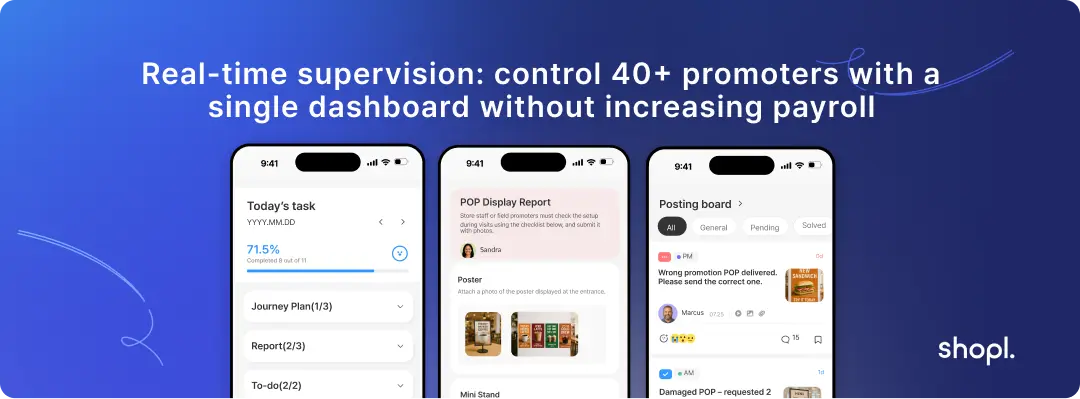
Supervising field teams in real-time is no longer a competitive advantage.
Today it's a minimum requirement to operate with:
• Efficiency — Fewer supervisors, more control
• Visibility — Know what's happening TODAY, not 3 days ago
• Scalability — Grow without supervision costs growing proportionally
• Prevention — Detect problems before they affect sales
• Profitability — Save up to $1M MXN annually in operational costs
And in Mexico, where margins are tight and competition is fierce, every peso counts.
The difference between growing in an orderly manner and losing control lies in the visibility you have of the field.
And that's not achieved with more supervisors.
It's achieved with better real-time information.
The question is not if you need digital supervision.
The question is: how much longer will you wait to stop paying for inefficient supervision?