샤플 이용료 80% 지원 받기

The practical guide to recover real control over field teams
In retail, one of the most costly—and least visible—problems is not the lack of personnel, but the lack of real control.
If you coordinate promoters, merchandisers, or supervisors, this probably sounds familiar:
• Visits that "were reported," but no one can verify them.
• Stores left unattended, but the report says "route completed."
• Check-ins at the same time every day.
• Evidence sent late... or never.
• And at the end of the month, the numbers don't add up.
The reality is clear: absences, lost visits, and false check-ins are not exceptions, they are symptoms of poorly designed processes.
In the Mexican market, these problems repeat for structural reasons:
If the system doesn't validate where the check-in is made, anyone can mark attendance from anywhere.
Excel and Google Forms allow:
• copying schedules
• modifying records
• filling out information hours later
When you review reports at the end of the day (or week), it's too late to correct.
Photos sent via WhatsApp:
• without store
• without time
• without location
• without traceability
Unrealistic routes generate:
• delays
• store skips
• "ghost" visits

Each visit that doesn't occur generates a chain of problems:
• Displays out of standard
• Poorly executed planograms
• Undetected out-of-stocks
• Incomplete activations
• Channel complaints
• Direct sales loss
And the most serious: the brand believes everything was executed correctly.
A modern system doesn't punish, it prevents.
It must allow you to detect:
✔ Check-ins outside the perimeter
If the promoter is not physically in the store, the system detects it.
✔ Unrealistic times
5-minute visits where they should be 30.
✔ Repeated schedules
Same time every day = immediate alert.
✔ Incomplete evidence
Check-in without photos or without completed tasks.
✔ Stores without visit
Planned routes vs. actual routes.
All of this in real-time, not at the end of the month.
They are communication tools, not retail execution tools.

Shopl is designed to prevent the problem before it occurs, not to correct it afterward.
• Mandatory real location
• Detection of falsification attempts
• Exact time and place record
Each visit includes:
• photos with metadata
• assigned store
• executed task
• responsible person
No "ghost" visits.
• Planned routes
• Compliance tracking
• Automatic detection of omitted stores
The HQ team can see:
• who already arrived
• who is delayed
• which store was not visited
• where the route broke
Nothing editable.
Nothing manual.
Nothing "interpreted."

Companies that migrate from manual processes to Shopl report:
• 50–60% fewer absences
• Almost total reduction of false check-ins
• Greater route compliance
• Better relationship with the channel
• Faster and better-informed decisions
Not because people work more, but because the system works better.
A typical flow:
• Upload stores
• Define routes
• Activate GPS check-ins
• Normal operation
• Daily supervision
• Route adjustments
• Report analysis
• Optimization
• Scaling
Without friction for the field team.
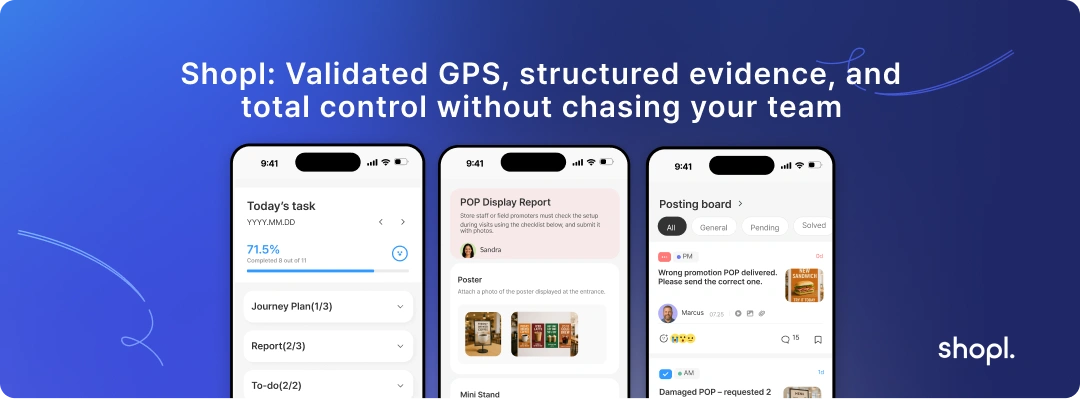
Absences, lost visits, and false check-ins are not a people problem, but a poorly designed systems problem.
When you have:
• location validation
• structured evidence
• real-time supervision
• automatic reports
The problem simply disappears.