샤플 이용료 80% 지원 받기

If you manage teams of promoters, supervisors, merchandisers, or activation coordinators in Mexico, there's an uncomfortable truth we all know:
Manual reports consume valuable hours... and almost never arrive complete, on time, or well organized.
WhatsApp, Excel, Google Forms, photos sent in parts, duplicate information, late reports, and messages in endless chains.
That chaos has a real cost for brands:
• Supervisors who lose half a day organizing photos
• Promoters who spend more time reporting than executing
• Scattered information impossible to analyze
• Zero daily visibility to make decisions
• Delayed KPIs because the final report takes days
And the worst part:
You can't improve what you can't measure.
That's why the most advanced companies today are migrating to automatic reports, where data generates itself while the team works.

Hours that should be used for supervision, execution improvement, or analysis.
Misspelled numbers, photos out of context, incorrect dates.
If reports arrive "at the end of the day"... stores already lost that day.
Each promoter reports differently.
Each supervisor interprets differently.
Each store seems like another story.
Without structured evidence, strategic decisions are based on assumptions.
It's not just about digitizing a form.
That's still manual, just prettier.
Eliminating manual reports means:
The app must capture:
• location
• timestamp
• store
• work category
• completed checklist
• photos
• completed tasks
All automatically.
The system does it alone, in ready-to-use dashboards.
Real-time KPIs.
Without friction. Without additional burden for the team.

Manual reports don't just consume time.
They consume opportunities, money, and team morale.
Weekly time invested:
• Promoters: 2 hours per person organizing photos and filling out forms
• Supervisors: 6 hours compiling information from their team
• Coordinators: 4 hours consolidating regional reports
Weekly total: $19,300 MXN
Monthly total: $77,200 MXN
Annual total: $926,400 MXN
And this is just the direct cost in time.
Indirect costs (even more serious):
❌ Late decisions — When the report arrives on Friday, you already lost the whole week to correct
❌ Lost opportunities — Out-of-stocks not detected in time = lost sales
❌ Team frustration — Promoters hate spending hours "doing homework"
❌ Unreliable data — Human errors make metrics inaccurate
❌ Impossibility to scale — More stores = more chaos in reports
Retail industry data in Mexico:
✓ 71% of supervisors dedicate more than 5 weekly hours just to consolidating reports
✓ 58% of field teams report that manual reports are their most frustrating task
✓ 64% of brands don't have real-time visibility of what's happening at POS
✓ 45% of manual reports contain errors or incomplete information
✓ Companies lose on average 20-30% of productivity due to manual administrative tasks
The question that changes everything:
"What would happen if you recovered 20 weekly hours from your team?"
You could:
✅ Visit 40% more stores
✅ Do 2 additional activations per month
✅ Improve field supervision
✅ Detect problems before they become crises
✅ Make decisions based on real data, not reports from 3 days ago
That's what eliminating manual reports means.

The app takes and classifies photos by store, category, and date.
GPS + automatic check-ins.
Automatic compliance checklist.
Visual before/after comparison.
Validation of each store visited, duration, and evidence.
Number-by-number visibility, without asking the team for anything.
Shopl was designed specifically to prevent teams from wasting time reporting and to focus on executing.
Each photo has:
• metadata
• location
• store
• user
• timestamp
And arrives at the correct dashboard, without human intervention.
No Excel.
No manual capture.
No data compilation.
The promoter just marks "completed" or uploads photo → the system does the rest.
Perfect for trade marketing managers:
• POP compliance
• Detected out-of-stocks
• Completed visits
• Duration per store
• Productivity by region
• Executed tasks
Brands that implement Shopl report:
• 20+ weekly hours recovered
• 40% more efficiency in visits
• 60% fewer "useless" photos
• 100% traceability in audits
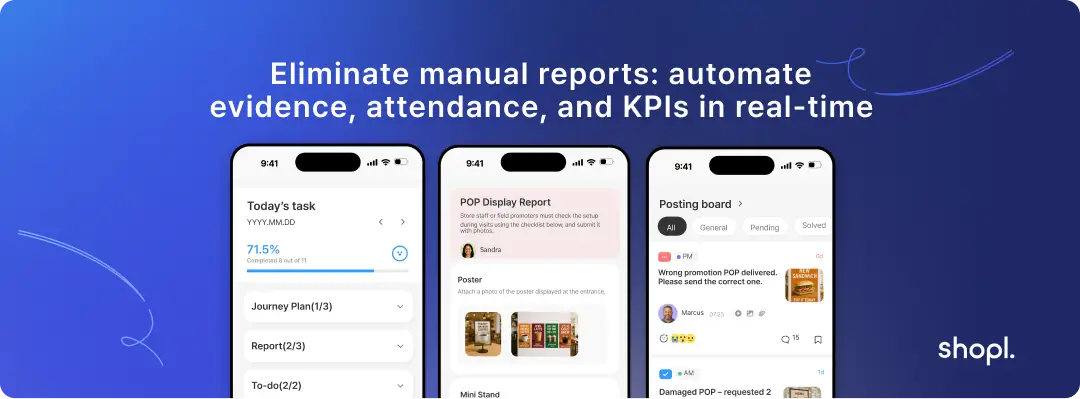
Attendance, POP, out-of-stocks, floor times, displays.
Everything that requires writing → should NOT exist.
Eliminating manual reports is not a luxury or a trend:
It's the only way for retail and trade marketing to operate with:
• speed
• precision
• real visibility
• more productive teams
• smarter decisions
Shopl allows your teams to execute and for you to have reliable data without asking for anything.
The question is not if you should automate your reports.
The question is: how much longer will you wait to recover those 20 weekly hours?