샤플 이용료 80% 지원 받기

The difference between reacting late and correcting on time in retail
In retail, most failures are not detected when they occur.
They're detected when they've already generated losses.
• An empty shelf that no one reported
• A poorly executed planogram that became "normalized"
• A promotion that was never set up
• POP material stored in the warehouse
• A visit that didn't happen
And when someone notices, the sale is no longer there.
The problem is not that failures occur.
The problem is not detecting them on time.
This blog explains how to identify point of sale failures before they impact sales, using real operational visibility, not intuition.

In Mexico, these failures usually hide for five key reasons:
Daily or weekly reports don't help correct the same day.
Photos without context don't allow identifying patterns.
It's reviewed when there's a complaint, not when there's risk.
Even though execution was deficient.
Everything depends on someone "noticing."
Thus, problems become invisible until they affect sales.
These are the most frequent at point of sale:
• Unreported out-of-stocks
• Incomplete displays
• Poorly executed planograms
• POP not installed
• Incorrect prices
• Expired promotions
• Competition invading space
• Visits that are too short
Each one, by itself, reduces conversion.
Together, they can destroy a category.

Detecting failures on time is not "reviewing more."
It's seeing the right thing, at the right time.
It means being able to:
• See stores without visit the same day
• Identify incomplete evidence in the moment
• Detect visits that are too short
• Compare execution between similar stores
• Recognize deviations before they repeat
• Prioritize immediate corrective actions
That's only achieved with real-time visibility.
Before a failure becomes a loss, there are always signals:
Indicates superficial execution.
Missing or repeated photos are an alert.
When one store executes very differently from the rest, something's wrong.
A store skipped today usually repeats tomorrow.
If not corrected quickly, it becomes structural.
These indicators allow acting before commercial damage.
WhatsApp, Excel, and manual reports fail because:
• They don't generate alerts
• They don't show deviations in the moment
• They don't connect evidence with metrics
• They don't allow easy comparison
• They depend on late human review
They are tools to document the past, not to manage the present.

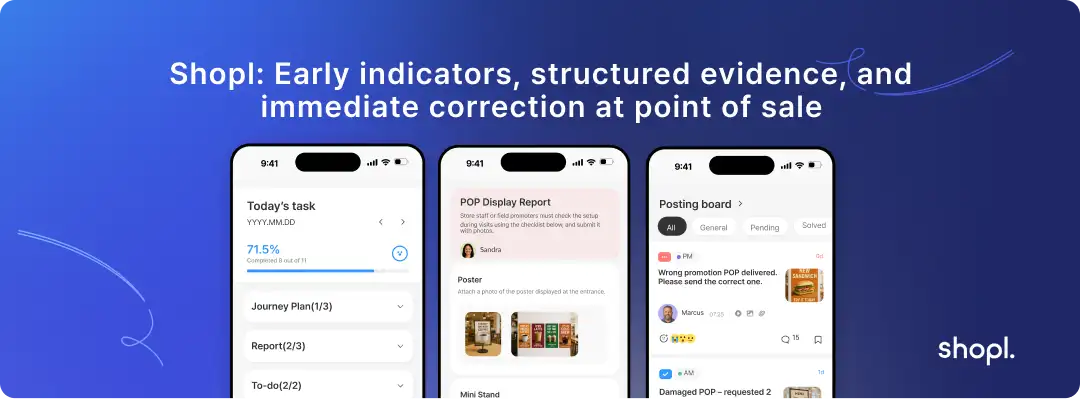
Shopl converts daily operation into an early detection system.
Allows seeing:
• Stores without visit
• Incomplete visits
• Delays
• Incidents
The same day, not after.
Each photo has:
• Store
• Time
• User
• Associated task
Which facilitates detecting patterns and anomalies.
You don't wait for reports:
• Data generates itself
• Deviations are seen immediately
Quickly identifies:
• Stores outside standard
• Promoters with low performance
• Zones with recurring problems
When detecting the failure, you can:
• Reassign visits
• Correct tasks
• Reinforce execution
• Prevent the problem from repeating
Brands that adopt this approach achieve:
• Fewer lost sales
• Better consistent execution
• Fewer reworks
• Greater channel control
• More aligned teams
• Faster decisions
Not because they work more,
but because they see earlier.
A practical approach:
Week 1
Define which critical failures you want to detect
Week 2
Activate structured evidence
Week 3
Visualize daily indicators
Week 4
Adjust routes, tasks, and priorities
Prevention is built step by step.
In retail, the problem is not failing.
The problem is failing without realizing it.
The brands that win are not those that correct better,
but those that detect earlier.
And that's only achieved with real operational visibility.