샤플 이용료 80% 지원 받기

Most trade promotions fail to deliver their projected ROI because of preventable execution mistakes rather than strategic flaws. The average trade promotion delivers only 60% of its expected return, with poor baseline calculation, execution gaps, and inadequate post-promotion analysis being the primary culprits.
Trade promotion management looks straightforward on paper: plan a discount, execute in stores, measure the lift. Yet most retailers see actual ROI fall 30-40% below projections. The gap isn't usually due to major strategic errors—it's the accumulation of small, preventable mistakes that compound over time.
The reality is that trade promotions involve multiple moving parts across different teams. Marketing creates the campaign, operations coordinates store execution, and finance measures the results. When any link in this chain breaks down, even slightly, the entire promotion's effectiveness suffers. A baseline calculation that's off by 10% can make a profitable promotion look like a failure, while poor store execution can turn a well-designed campaign into a costly mistake.
The most successful trade promotion managers focus on preventing common pitfalls rather than trying to create perfect campaigns. They understand that consistent execution of good promotions beats sporadic execution of great ones.
Many promotion managers start planning without establishing what "normal" sales look like for their products. This creates a fundamental problem: you can't measure incremental lift if you don't know where you started. When baseline assumptions are wrong, ROI calculations become meaningless.
Consider a scenario where you assume baseline weekly sales of 1,000 units, plan a promotion expecting 30% lift, and see actual sales of 1,200 units during the promotional period. On paper, you achieved 20% lift—not bad. However, if the true baseline was actually 1,100 units due to seasonal trends you missed, your incremental lift was only 9%.
The consequences extend beyond measurement errors. Inaccurate baselines lead to wrong discount levels, either leaving money on the table with unnecessary deep discounts or failing to drive sufficient volume with shallow ones. They also make it impossible to optimize future campaigns since you're working with flawed success metrics.
Establish your baseline using a 4-6 week average from the same period last year, adjusted for any major changes in distribution, pricing, or market conditions. This approach accounts for seasonal patterns while remaining simple enough for regular use.
For newer products without historical data, use category benchmarks from similar SKUs in your portfolio. Track weekly sales for at least 8 weeks before your first major promotion to establish a reliable baseline. Most importantly, document any external factors during your baseline period—competitor promotions, supply disruptions, or unusual events—that might skew the data.
Running simultaneous promotions across related products or categories often creates unintended cannibalization. A promotion on premium shampoo might steal sales from your regular shampoo promotion running the same week, reducing the net incremental volume for both campaigns.
This mistake is particularly common in larger organizations where different teams manage various product lines or channels. The trade marketing team runs a national promotion while regional teams layer on additional discounts, creating a complex web of overlapping offers that confuse consumers and erode margins.
The real cost isn't just reduced effectiveness—it's the missed opportunity for sequential promotions that could have delivered higher total incremental volume. Instead of two promotions each delivering 20% lift, you end up with two promotions combining for 25% lift while doubling your promotional costs.
Before launching any promotion, run through this quick checklist:
Track cross-elasticity between products during past promotions to understand which combinations work synergistically and which create destructive overlap. Most categories have 2-3 products that should never be promoted simultaneously due to high substitution rates.
Every successful promotion creates some degree of pantry loading—consumers buy more than they immediately need, then reduce purchases in subsequent weeks. The deeper the discount, the longer the post-promotion dip. Managers who ignore this effect overestimate true incremental lift and make poor decisions about promotion frequency and depth.
A typical scenario: your promotion delivers 40% volume lift during the promotional week, but sales drop 15% below baseline for the next three weeks. The net incremental volume might be only 10% when you account for the full cycle. Understanding this pattern is crucial for accurate ROI calculation and optimal promotion timing.
The pantry loading effect varies significantly by category. Non-perishable goods with long shelf lives show stronger post-promotion dips than perishables. High-frequency purchase categories recover faster than low-frequency ones. Household staples often see 4-6 weeks of reduced sales following major promotions.
To measure true incremental lift, track sales for 6-8 weeks following each promotion. Calculate the total volume during this extended period and compare it to what you would have expected without the promotion. The difference is your true incremental volume.
Use this formula: True Incremental Lift = (Total Volume During + After Promotion) - (Baseline Volume × Number of Weeks Measured). This approach reveals which promotions actually grow category consumption versus merely shifting timing of purchases.
Document the recovery pattern for each product and promotion type to improve future planning. Some products show quick recovery within 2-3 weeks, while others take 6-8 weeks to return to baseline. This data helps determine optimal gaps between promotions.
Research consistently shows that 40% of planned trade promotions fail to execute properly at store level. Common execution failures include late starts, incorrect pricing, poor product placement, inadequate inventory, and missing promotional materials. Each failure reduces promotional effectiveness and wastes marketing investment.
The execution gap is particularly problematic because it's often invisible to headquarters teams. Sales data might show disappointing results, but without store-level visibility, managers assume the promotional strategy was wrong rather than the execution. This leads to strategy changes when process improvements were actually needed.
Store-level execution failures have cascading effects. Poor shelf placement reduces promotional visibility. Incorrect pricing confuses consumers and may violate retailer agreements. Missing promotional signage eliminates the psychological trigger that drives impulse purchases. Any single execution failure can reduce promotional lift by 20-30%.
Implement these weekly checkpoints during promotional periods:
Assign specific team members to conduct compliance checks within 48 hours of promotion launch. Use mobile apps or simple checklists to standardize reporting and ensure nothing falls through the cracks. The cost of compliance monitoring is minimal compared to the cost of failed execution.
Many managers focus exclusively on volume metrics—units sold, percentage lift, market share gains—without adequately considering profitability. A promotion that delivers 50% volume lift while destroying margins might be less valuable than one delivering 25% lift with better profit retention.
The volume-focused approach becomes particularly problematic when evaluating different promotional mechanisms. A BOGO (Buy One, Get One) promotion might deliver higher volume lift than a 25% discount, but the 25% discount could generate better profit margins per incremental unit. Without profit-focused metrics, you'll optimize for the wrong outcomes.
Trade promotions also have hidden costs that rarely appear in initial ROI calculations. Promotional materials, additional inventory carrying costs, expedited shipping to prevent stockouts, and increased customer service volumes all erode profitability. The true cost of trade promotions is typically 15-25% higher than the obvious promotional discount.
Build your ROI calculation using this comprehensive framework:
Calculate ROI using incremental gross profit rather than revenue. This approach accounts for the fact that promotional volume often comes at lower margins and helps identify which promotional types generate the best returns.
Competitors rarely ignore successful promotions, especially in highly competitive categories. A well-planned promotion can quickly become unprofitable when competitors match or exceed your promotional pricing. Without advance planning for competitive responses, you're essentially gambling with your promotional budget.
Common competitive reactions include immediate price matching, counter-promotions on substitute products, increased advertising spend, or aggressive trade deals with retailers. The most damaging scenario is when competitors launch deeper promotions on similar products, forcing you to either accept reduced effectiveness or escalate promotional spending beyond profitable levels.
The timing of competitive responses varies by category and competitive intensity. In fast-moving consumer goods, responses often occur within days. In more strategic categories, competitors might wait to see your promotion's effectiveness before responding, giving you a brief window of exclusive benefit.
Monitor these key indicators before and during promotional periods:
Develop contingency plans for likely competitive scenarios before launching promotions. Know in advance whether you'll match competitive responses, pivot to different products, or accept reduced effectiveness while maintaining profitability.
Most organizations conduct post-promotion analysis too late to capture actionable insights or too early to understand full impact. The optimal timing for comprehensive analysis is 2-3 weeks after promotion end, allowing enough time for pantry loading effects to manifest while keeping insights fresh for future planning.
Immediate post-promotion reviews (within 2-3 days) should focus on execution issues and obvious problems. Did the promotion start on time? Were there inventory issues? Did pricing execute correctly? These operational insights can improve current campaigns if issues are caught early.
The deeper strategic analysis requires more time. Consumer behavior patterns, competitive responses, and true incremental calculations need several weeks of data to become clear. Analysis conducted too early often misses crucial insights about promotion effectiveness and long-term impact.
Structure your post-promotion analysis around these critical questions:
Document specific, actionable insights rather than general observations. Instead of "execution could be better," note "stores with dedicated promotional displays generated 35% higher lift than those with regular shelf placement." These specific insights drive meaningful improvements in future campaigns.
Successful trade promotion management requires systematic data collection from your first campaign. Without consistent measurement, you'll repeat the same mistakes and miss optimization opportunities. Start with these fundamental data points:
Baseline performance metrics should include weekly sales volume, profit margins, inventory turns, and customer purchase frequency for each promoted SKU. Track these metrics for at least 12 weeks before your first promotion to establish reliable benchmarks that account for seasonal variations.
Execution tracking must cover promotional start/end dates, actual vs. planned pricing, display compliance, inventory availability, and promotional material placement. Use mobile apps or simple check-in systems to capture store-level execution data in real-time rather than relying on end-of-period reports.
Institute a structured weekly review during promotional periods that covers execution status, sales performance versus expectations, competitive activity, and inventory levels. These reviews should take 15-20 minutes and focus on actionable issues that can be corrected while the promotion is still running.
Track key performance indicators that predict promotional success: week-over-week volume changes, execution compliance rates across locations, inventory turn rates, and early consumer response indicators. Establish clear escalation triggers—if execution falls below 80% compliance or volume trails projections by more than 20%, immediate action plans activate.
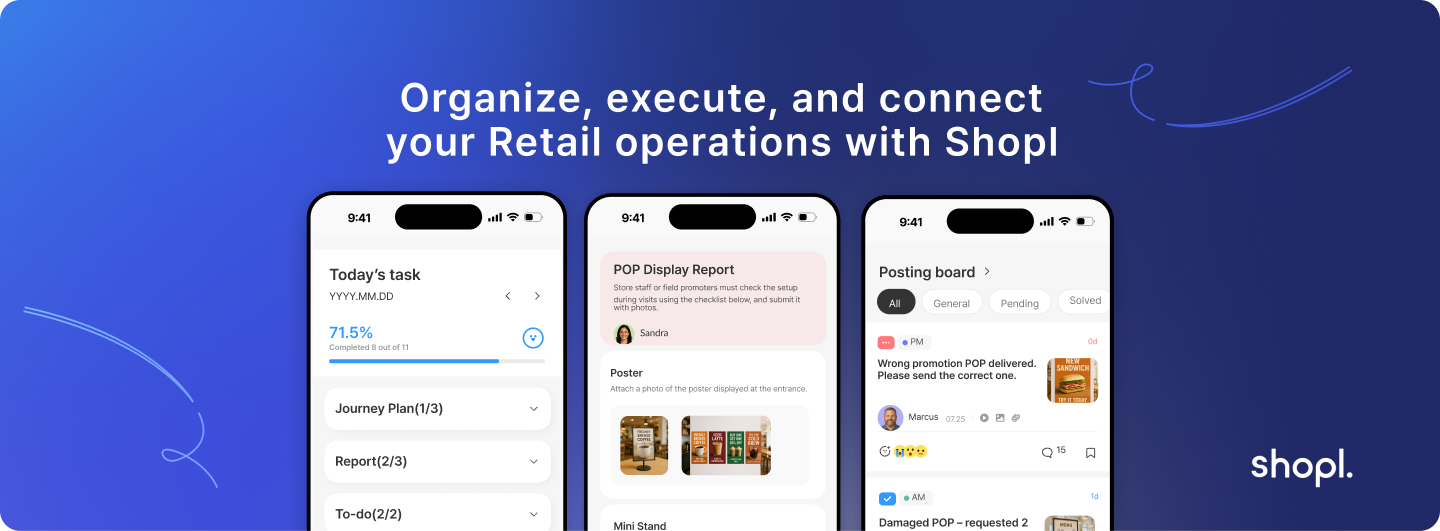
For organizations managing multiple promotions simultaneously, consider using integrated platforms that centralize promotional data and automate routine analysis. Shopl's trade promotion features help coordinate execution across multiple locations while tracking the performance metrics that matter most for ROI optimization. The platform's real-time reporting capabilities make it easier to spot execution problems before they damage promotional effectiveness. Learn more about managing promotional campaigns efficiently at Shopl's features page, or explore detailed operational guidance in the help center.
A. A good trade promotion ROI varies by industry and category, but most successful promotions deliver 15-25% incremental profit after accounting for all costs. High-velocity consumer goods often achieve 20-30% ROI, while durables might see 10-20%. The key is measuring true incremental profit rather than just volume lift, since deeper discounts can generate impressive volume numbers while destroying profitability.
A. Wait 6-8 weeks after promotion end to calculate final ROI, allowing time for post-promotion sales patterns to stabilize. However, conduct immediate execution reviews within 2-3 days and preliminary performance assessments at 1 week to catch problems early. The extended measurement period captures pantry loading effects and competitive responses that significantly impact true promotional effectiveness.
A. Small retailers can implement effective trade promotion management using simple, systematic processes rather than expensive software. Start with basic spreadsheet tracking of baselines, execution checkpoints, and post-promotion analysis. Focus on preventing the common mistakes outlined in this article—many of which cost nothing to avoid but save significant money when prevented.
A. Plan competitive response scenarios before launching promotions and establish clear decision criteria for each situation. If competitors match pricing, you might maintain your promotion to avoid appearing weak, switch to non-price promotional elements like added value, or accept reduced effectiveness while maintaining profitability. The worst approach is making reactive decisions without predetermined criteria.
A. Poor store-level execution is the biggest predictor of promotional failure. If your promotion isn't properly implemented in stores—wrong pricing, poor placement, missing materials, inadequate inventory—no amount of strategic brilliance will save it. Establish execution compliance checks within 48 hours of launch and have correction processes ready to deploy immediately when problems arise.
Effective trade promotion management isn't about avoiding all mistakes—it's about systematically preventing the most common and costly ones. The organizations that achieve consistently strong promotional ROI focus on execution excellence rather than constantly chasing new promotional strategies. By implementing systematic baseline calculation, execution tracking, and post-promotion analysis, you'll join the small percentage of managers who consistently deliver on promotional projections while building organizational capabilities that compound over time.