샤플 이용료 80% 지원 받기

Inconsistent interview evaluations don't just slow down hiring — they lead to bad hires, early turnover, and teams that never quite fit together. When every interviewer is working from a different mental checklist, the final decision often comes down to personal preference rather than what the role actually needs. This article walks through how to design interview evaluation criteria that keep your whole team aligned — from the first interview through onboarding.
Interview evaluation criteria are the shared framework that defines what you're assessing (e.g., communication skills, motivation) and what "good" looks like at each score level. Without both pieces, you don't have a standard — you have a suggestion.
In practice, this means Interviewer A scores a candidate highly because they came across as confident and articulate, while Interviewer B scores the same person low because they seemed rehearsed and lacked genuine enthusiasm. Neither is wrong — they're just measuring different things. Without a shared standard, the final hiring decision reflects whoever had the strongest opinion in the room, not which candidate best fits the role.
Getting your criteria aligned delivers three concrete benefits:
The shift from "hiring someone who felt right" to "hiring someone who fits what this role actually demands" is where hiring quality is won or lost.
Start by getting your hiring team and floor managers in the same room to answer: "What do our best performers have in common?" and "What situations tend to trip people up in this role — and what does handling those well look like?" The answers to those questions become your evaluation criteria.
Skip this step, and you end up with a generic scoresheet that could apply to any job at any company — which means it won't reliably surface the right people for yours.
What makes a great store associate is fundamentally different from what makes a great supervisor (SV). Each role — and each level — needs its own evaluation criteria. If you're reusing the same scoresheet across all positions, there's a good chance you're missing the questions that actually predict success in each one.
It's also worth noting that fair hiring practice standards in most markets require that evaluation criteria be directly tied to job-relevant competencies. When designing your criteria, make sure every item you score can be clearly linked back to what the role requires.
Most interview evaluations can be organized around five categories. Mapped to the Will-Can-Must framework commonly used in hiring: ① Skills & Experience = Can, ② Motivation & Interest = Will, and ③–⑤ = Must (the requirements tied to the role and organization).
Relevant work history, specific technical skills, and certifications. This is the most objective dimension — it answers "Can this person actually do the job?"
How well does the candidate understand what this role and company are about — and why do they want it? Push past surface-level answers to understand what they're actually trying to achieve. This is one of the strongest predictors of whether someone stays or leaves within the first year.
How someone thinks about teamwork, accountability, and the day-to-day realities of the job. A candidate can have strong skills and still struggle badly if their working style clashes with your team's culture — and that mismatch is a common driver of early attrition.
In a retail or multi-site environment, this goes well beyond customer-facing interactions. How someone communicates within the team, escalates issues, and keeps HQ informed is just as important as how they handle a difficult customer.
Can this person break down a problem, prioritize what matters, and come up with a clear course of action? For manager, SV, or HQ-facing roles, this is often the most critical dimension to assess.
5-point scales are the default, but they have a well-known problem: interviewers tend to cluster around the middle score, making it hard to differentiate candidates. A 4-point scale removes the "neutral" option and forces a clearer judgment call on every item.
Defining a criterion as "strong communication skills" tells different interviewers very different things. What actually aligns scores is a behavioral anchor for each level — for example: "4: Understood the intent behind questions and answered with specific, concrete examples" vs. "2: Responses were surface-level and the candidate struggled noticeably when pushed for more detail." The more specific the description, the less room there is for interpretation drift.
Even with a shared scoresheet, individual interviewers will naturally drift toward their own interpretations over time. A calibration session — where interviewers score independently and then compare before any group discussion — helps catch and correct those gaps before they compound. Running these regularly is one of the most effective ways to maintain scoring consistency across your team.
Three biases worth actively watching for:
The real test of your evaluation criteria comes after the hire. Tracking what actually happens — "We scored this person highly, but they left within three months" or "We had reservations, but they turned out to be one of our best performers" — tells you where your criteria are accurate and where they're misleading you. Build in a formal review every six to twelve months so your hiring standards improve alongside your team.
Evaluation criteria, scoresheets, and rubrics aren't just tools for making a hiring decision. Their full value is realized when multiple interviewers use the same standards consistently — and when what you learned in the interview actually informs how you bring that person on board and develop them.
For organizations running multiple locations or coordinating hiring between HQ and local managers, having a single, standardized set of criteria that everyone can access and apply is especially critical.
Different roles need different criteria. A store associate scoresheet should weight customer handling, teamwork, and the ability to learn procedures quickly. A store manager or SV scoresheet should put more emphasis on problem-solving and operational oversight. The structure can be consistent — the priorities should reflect what each role actually demands.
But even well-designed criteria break down if every interviewer is working from a different version of the document — or worse, relying on what someone told them verbally. When interview questions, scoring rubrics, and evaluation guidelines all live in one place and everyone is looking at the same version, drift stops before it starts.

Shopl's Notice Board feature lets you organize role-specific interview criteria, question guides, and hiring policies by topic — accessible to everyone from HQ to store managers to SVs. When criteria are updated, one edit updates everyone's view, so your team is always working from the same standard.
The interview surfaces real information about where a candidate is strong and where they'll need support. That information shouldn't disappear once the offer is signed.
If someone showed they'd need more time to get comfortable with procedures, break the initial training into smaller steps. If they have limited floor experience, front-load hands-on practice and early feedback into their schedule. The interview findings give you a head start on building a development plan that actually fits the individual.
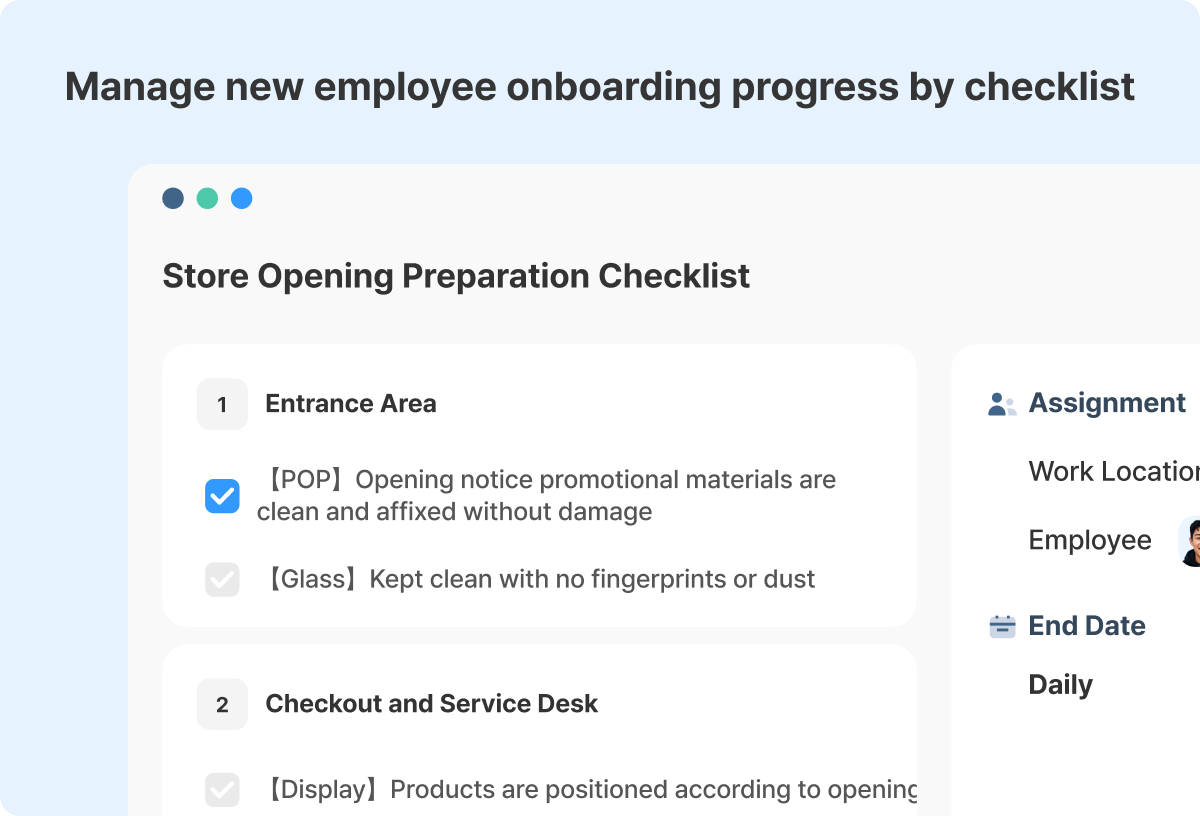
With Shopl's To-Do (Task Management) feature, onboarding checklists can be built out by role and assigned to new hires directly. Managers can see completion status at a glance and follow up on anything that's fallen behind — so the picture you built during the interview stays connected to how the person is actually developing on the floor.
A. Rather than one sheet for all roles, the more effective approach is a shared base with role-specific sections layered on top. At minimum, weight the criteria differently for store associates, leads and shift supervisors, and SVs or managers — because what predicts success in each role is genuinely different.
A. This usually means the behavioral anchors for each score level aren't specific enough. If interviewers have to interpret what a "4" looks like, they'll each interpret it differently. Rewrite the rubric so each score is defined by observable, specific behaviors — things an interviewer could point to in their notes. Then run a calibration session where interviewers score a candidate independently before comparing, and do this regularly to keep everyone aligned.
Interview evaluation criteria aren't just a hiring tool — they're an operating standard for how your organization assesses and develops people consistently. When the criteria are well-defined, shared across your team, and connected to what happens after someone is hired, you get more consistent decisions, faster onboarding, and fewer surprises on the floor. The goal isn't to build the perfect scoresheet once and leave it alone — it's to treat your criteria as a living document that gets sharper as your team learns what actually predicts success in your environment.